Pages

Wednesday, September 23, 2015

28 CYNICAL OBSERVATIONS FROM ONE HENRY MILLER RIDE


Whenever I have bouts of cynicism, periods of pervasive pessimism—and they’re not infrequent—I try to remedy the situation with occasional travel. That may mean physical forays into the American outback (setting a course for, say, Utopia, Texas) or fantastical forays into the literary realm (“After all, tomorrow is another day”).

Sometimes, it’s a combination of the two. My first travel memoir, States of Mind, chronicled a 314-day cross-country excursion in 1995-96 that essentially was a cynical Generation Xer’s attempt to find out if that cynicism was justified—did I reflect the state of the union, or merely misjudge it? So I turned that figurative notion into a literal search for virtue in America – in places like Pride (Alabama), Justice (West Virginia), Honor (Michigan) and Wisdom (Montana).
So it was a hopeful expedition.

I would say most literary travelers allow sanguinity to ride shotgun. As Mark Twain once declared, “Travel is fatal to prejudice, bigotry, and narrow-mindedness.” We journey in search of something better.

Well, most of us do. Then there’s Henry Miller.

He’s best known toeing the obscenity/literary line in novels like Tropic of Cancer, but he also wrote a cross-country travel memoir. And it was about as hopeful as a pothole. It was brimming with condescension and despair, grumpiness and gloom. “One’s destination is never a place,” he wrote, “but a new way of looking at things.” Yet he seemed to pack a suitcase full of old biases and mean-spirited generalities, which colored his view of the American scene (after a long stay in Europe) during one cross-country trip in 1940-41.

He called his travel memoir The Air-Conditioned Nightmare.

I’ve selected 28 cynical statements from his journey. There were far more to choose from:

1. “A great change had come over America… Everything was cock-eyed and getting more and more so. Maybe we would end up on all fours, gibbering like baboons.”

2. “The lack of resilience, the feeling of hopelessness, the resignation, the skepticism, the defeatism—I could scarcely believe my ears at first. And over it all that veneer of fatuous optimism—only now decidedly cracked.”

3. “I, on the other hand, always expect angels to pee in my beer.”

Wednesday, September 16, 2015

55 NUGGETS OF TRIVIA FROM THE SPORTS 100


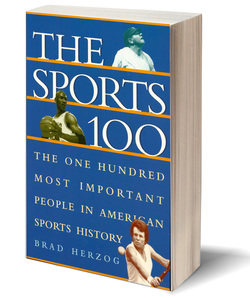
My favorite nonfiction books are the ones that examine oft-mined subjects from a new point of view, whether that means Malcolm Gladwell’s The Tipping Point or Jim Bouton’s Ball Four. So early in my career, I wrote one of my own. Twenty years ago, in 1995, I produced a book called THE SPORTS 100, published by Macmillan. It was a ranking and profile of the one hundred most important people in American sports history.

The book judges influence, not athletic prowess. If all you can say about someone was that he was the best quarterback or hit this many home runs or won that many U.S. Open titles, that isn’t enough. There are too many stars in the world of sports to have included people for star power alone. You won’t find Ted Williams or Joe Montana or Steffi Graf. But you will find jump shot pioneer Hank Luisetti and vilified baseball owner Walter O’Malley and influential bookmaker Charles McNeil. It is an attempt to show that there are relative unknowns who left more of an imprint than a great many legends.

Another aim of The Sports 100 is to put the games into historical perspective, to show how its cultural influence often manifests itself in a handful of significant individuals—from Joe Louis and Jackie Robinson to Billie Jean King and Arthur Ashe. The book also highlights the many cases in which one person was largely responsible for introducing an eventually monumental element of sports—be it free agency, the point spread, the minor league farm system, or the forward pass. In fact, it is not only a study of 100 remarkable people, but also of 100 components of sport’s evolution. It is as much a history of the games as a profile of the participants.

In the end, the list is as diverse as sport itself. There are athletes and innovators, activists and academics, executives and inventors, journalists and judges, agents and outcasts, pioneers, producers, promoters and presidents—all of whom made a lasting impact, in one way or another, on American athletics. Of course, readers were bound to disagree with many of the selections and omissions. But like the old argument about New York’s greatest centerfielder, it’s all a matter of perspective.

Unfortunately, the book is long out of print. If you want a copy, you’ll just have to contact me personally. And if you want some interesting bits of trivia that I discovered along the way, well, there’s plenty of that.

Sunday, September 6, 2015

37 INSIGHTS FROM THE IMAGINATION OF DR. SEUSS


In the pantheon of the profound—Churchill and FDR, Shakespeare and Twain, even Will Rogers and Woody Allen (if you prefer mirth while musing), we at the Why Not 100 think Dr. Seuss belongs. Really. He did it through allegory and whimsy, substituting edifying imagination for speechifying exhortations, replacing rim-shot one-liners with Once-lers and wonders. Indeed, many of his most famous passages are designed just as much to enlighten as to entertain.

Most of them are life-affirming perspectives—every person counts and should try new things and can save the world one speck or tree at a time. They’re the kind of reminders that lodge firmly in a child’s psyche—brain-remainers, he might call them. Sometimes, too, Seuss tossed in some gentle barbs, kindly poking fun at the excesses of authority or income disparity or the diffusion of responsibility. And once in a while, he just comments on love or imagination or gratitude or 
aging.

We’ve chosen our 37 favorites:

1. “You have brains in your head. You have feet in your shoes. You can steer yourself any direction you choose.” (Oh, The Places You’ll Go!)

2. “Don’t give up! I believe in you all. A person’s a person, no matter how small!” (Horton Hears a Who)

3. “In the places I go there are things that I see that I never could spell if I stopped with a Z. I’m telling you this ‘cause you’re one of my friends. My alphabet starts where your alphabet ends.” (On Beyond Zebra)

Monday, August 31, 2015

96 BOOKS WITH NUMBERS IN THE TITLE


When my son Luke started reading in earnest—that is, when he found that he had made his way through enough contemporary fantasy novels to fill the libraries of Rivendell and Hogwarts—I began to suggest some older classics.

He had already read the three books in the Lord of the Rings trilogy, including The Two Towers, which was his favorite one. How about Jules Verne, I said. Around the World in Eighty Days or Twenty Thousand Leagues Under the Sea. Then I got him hooked on Sherlock Holmes, starting with Arthur Conan Doyle’s The Sign of Four. For good measure, I led him to Agatha Christie’s classic And Then There Were None.

See a pattern? We at the Why Not100 obviously treasure the written word, but there sure are a lot of classics with numbers in the title, whether it’s 1984, Seven Years in Tibet, or North Dallas Forty. Hence, the following list.

Only once, as you’ll see, do we reference Janet Evanovich, who has written twenty numbered Stephanie Plum mysteries—from One for the Money, Two for the Dough, and Three to Get Deadly to Explosive Eighteen, Notorious Nineteen, and Takedown Twenty.

You may also notice, when you get to number 50, that a certain erotic novel didn’t make the cut.

1. One Flew Over the Cuckoos Nest (Ken Kesey)
2. A Tale of Two Cities (Charles Dickens)
3. The Three Musketeers (Alexandre Dumas)
4. The Sign of the Four (Arthur Conan Doyle)

Monday, August 24, 2015

40 INITIALIZED AUTHORS AND THEIR REAL NAMES


Ever consider that most of us don’t necessarily know the first name of the authors of such classics as The Hobbit, The Chronicles of Narnia, The Wizard of Oz, Curious George, Mary Poppins, Charlotte’s Web, and Winnie the Pooh? Or The Catcher in the Rye? Or The War of the Worlds? Or, for that matter, The Sixth Sense?

Oh, and the Harry Potter series, too. Joanne Rowling was asked by her publisher to adopt a more masculine pen name. So she borrowed her grandmother’s name (Kathleen) and became forever famous as J.K. Rowling. Much the same process happened with Susan Eloise (better known as S.E.) Hinton, author of The Outsiders.

So let’s take a tour of initials and explore the real names behind some literary icons.

1. J.R.R. Tolkien (John Ronald Reuel)
2. W.E.B. Du Bois (William Edward Burghardt)
3. J.K. Rowling (Joanne Kathleen)
4. C.S. Lewis (Clive Staples)
5. E.B. White (Elwyn Brooks)

Sunday, August 16, 2015

33 SUPER-SHORT BOOK TITLES


I just finished reading a really unusual book called “S.” It was conceived by J.J. Abrams, the brilliant guy behind the TV series “Lost,” which I absolutely loved until I absolutely hated it. (I felt like it was equivalent to reading a 3,000-page Sherlock Holmes mystery in which none of the clues actually wound up mattering because it was all a morphine-fueled excursion into another dimension). Abrams is also the guy who was handed the keys to the modern film versions of Star Trek and Star Wars and Mission Impossible. Brilliance begets good fortune—and a certain pop culture responsibility.

But about the book… “S” is an idea that would have been immediately discarded as far too expensive and outside-the-box if it had been proposed by just about anyone less creatively successful. As Abrams tells it, he was at LAX more than a decade ago, when he came across an abandoned book signed by a mysterious woman named Janet. It sparked an idea that was finally realized when he recruited novelist Doug Dorst to write up a tale (two tales, actually) and Mulholland Books to publish it.

The tagline: One book. Two readers. A world of mystery, menace and desire.

A young woman picks up a book left behind by a stranger who, as evidenced by his notes written in the margins, is entranced by the story (a novel called Ship of Theseus) and the enigmatic writer (a secretive and mysterious fellow called V.M. Straka). The readers—a college senior named Jennifer and a disgraced grad student named Eric—eventually begin to write to each other on the pages of the book. So it is essentially a double-story-intertwined. One is a mysterious sort of adventure tale, the other a beguiling sort of love story in the margins. What a cool idea.

It is basically two books in one, and “S” is the title of the meta-concept. Thus it is a long read with a short title. Add here’s where I finally get to the point of this post—it’s not even the first book called “S.” John Updike wrote one. And several authors wrote a collaborative novel of the same name. And Thomas Pynchon wrote “V.” Andy Warhol wrote “A.”

Here are 33 of the shortest book titles you’ll ever come across—along with a very short synopsis of each:

Sunday, August 9, 2015

38 TOWNS THAT CELEBRATE CLASSIC LITERATURE


August 9 is National Book Lovers Day. So I’m going to explore that in a literal sense.

There used to be a couple of communities in Florida, both of them settled sometime in the 1850s. One had a few general stores and some other businesses. The other boasted, at the very least, a post office. The towns were only about two miles apart, each one’s destiny certainly intertwined with the other’s. But today both are no more. They’re dead.

Their names? Romeo and Juliette.

Okay, so the spelling of the latter is a bit off. But c’mon, doesn’t that give you ghost town goosebumps?

Then again, there are plenty of Shakespearean places that you can visit during a cross-country excursion. We can start with a place called, well, Shakespeare, located in southwestern New Mexico, just south of the city of Lordsburg. That one’s a ghost town, too—much ado about nothing, one might say. But Shakespeare, New Mexico, actually offers occasional tours. And, in perhaps the ultimate anachronism, it has a website (shakespeareghosttown.com).

Want to further immortalize the Immortal Bard in the form of an epic road trip? Try this somewhat manageable itinerary:

1. Bard (California)
2. Romeo (Colorado)
3. Shakespeare (New Mexico)